New Jersey Democrats are openly demanding that the United States Postal Service defy President Trump’s executive order aimed at securing the 2026 midterm elections, exposing a stunning willingness to undermine federal election integrity measures in favor of maintaining vulnerable mail-in voting systems.
Democrats Demand Postal Service Ignore Presidential Order
Representative Nellie Pou spearheaded a letter on April 6, 2026, alongside nine fellow New Jersey congressional Democrats—including Senators Cory Booker and Andy Kim—urging Postmaster General David Steiner to refuse implementation of President Trump’s election security executive order. The letter brazenly requests a federal agency ignore a direct presidential directive designed to prevent ineligible individuals from casting ballots. Democrats framed their demand as protecting state sovereignty, yet their opposition reveals deeper concerns about losing the vulnerabilities inherent in loosely monitored mail-in voting systems that have fueled conservative suspicions since the dramatic expansion of absentee voting.
Executive Order Implements Common-Sense Verification Measures
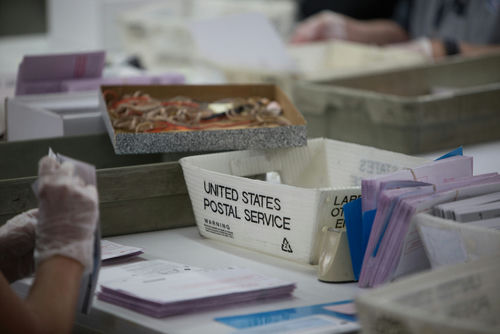
President Trump signed the executive order on March 31, 2026, directing federal agencies to compile comprehensive lists of verified citizens and requiring USPS to cross-check mail-in ballots against these lists before transmission. The order bars postal workers from handling ballots from individuals not appearing on verified citizen registries, implements barcode tracking for accountability, and prioritizes prosecution of state officials who issue ballots to ineligible voters. These measures represent straightforward safeguards that any American concerned about election integrity would recognize as basic due diligence. The order addresses legitimate concerns about non-citizens voting, a practice Democrats consistently dismiss despite documented cases and common-sense recognition that illegal immigrants have incentives to support policies favoring open borders.
Constitutional Authority Supports Federal Election Standards
Democrats claim Trump’s order violates state authority over elections, citing Article I, Section 4 of the Constitution. However, this selective constitutional reading ignores federal supremacy over citizenship determination and immigration enforcement—core constitutional powers explicitly granted to the federal government. The executive order does not dictate state election procedures but rather ensures federal resources like USPS are not complicit in transmitting ballots from non-citizens. States retain control over polling locations, ballot design, and counting procedures, while the federal government exercises legitimate oversight ensuring only eligible citizens participate. Previous court blocking of a 2025 Trump order requiring citizenship proof does not establish permanent precedent, particularly when different legal arguments and circumstances apply to postal service involvement versus state-level requirements.
New Jersey’s Resistance Exposes Partisan Priorities
Governor Mikie Sherrill called the order illegal and claimed it was “designed to make it harder for eligible citizens to vote,” a predictable Democratic talking point that conflates security measures with suppression. Lieutenant Governor and Secretary of State Dale Caldwell emphasized that three voting methods remain unchanged in New Jersey, inadvertently admitting the order poses no actual barrier to legitimate voters. The state’s resistance, coupled with lawsuits from multiple Democrat-controlled states, suggests coordinated opposition prioritizing political advantage over electoral integrity. New Jersey Democrats tout their state’s mail-in safeguards implemented post-2022, including labeled ballots and multi-agency fraud monitoring, yet vigorously oppose federal verification that would complement these measures. This inconsistency raises questions about whether existing state protections are genuinely robust or merely performative gestures designed to provide cover for vulnerable systems.
Implications for 2026 Midterms and Beyond
The executive order arrives ahead of the 2026 midterm elections and New Jersey’s April 2026 special election in the 11th congressional district, timing that Democrats characterize as suspicious but conservatives recognize as appropriate preparation. Legal challenges will likely delay implementation, mirroring the 2025 court block of Trump’s citizenship proof requirement, giving Democrats temporary victory while prolonging systemic vulnerabilities. Long-term implications extend beyond New Jersey, as the confrontation establishes precedent for federal-state tensions over election administration and may force legislative clarification of USPS roles in ballot handling. Americans reliant on mail-in voting—including seniors, military personnel, and disabled citizens—deserve assurance that only eligible voters participate, a goal Trump’s order advances despite Democratic characterizations as voter suppression targeting these very populations.
Sources:
N.J. Dems call on USPS to refuse to comply with Trump mail-in ballot executive order
NJ Dems Demand USPS Reject Trump Mail Order
Trump’s mail-in voting executive order faces pushback from N.J. leaders