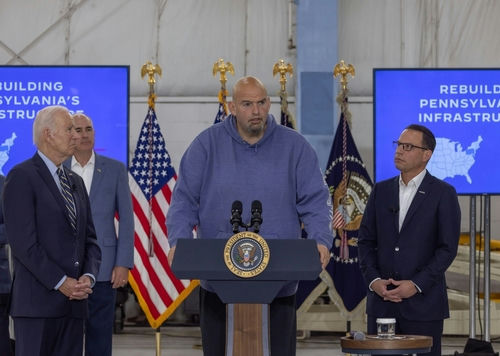
Senator John Fetterman flatly rejected mounting speculation about abandoning the Democratic Party, declaring a switch to Republicans “is not gonna happen” and that he would make a “pretty bad Republican senator.”
GOP’s Quiet Recruitment Push Meets Firm Resistance
Republican operatives have mounted a deliberate but low-profile effort to recruit Senator Fetterman, viewing the Pennsylvania Democrat as vulnerable to defection. The strategy capitalizes on Fetterman’s visible friction with state Democratic leadership, staff turnover, and his public criticism of Democratic extremism—including accusations of “Trump Derangement Syndrome.” GOP leaders see opportunity in his contrarian positions on fracking, Iran policy, and anti-Semitism, where he has aligned with Republican concerns. Pennsylvania’s Republican Party chairman even dangled potential party support for Fetterman’s 2028 re-election bid, contingent on a party switch. However, Fetterman has consistently rebuffed these overtures, both privately to Senate Democratic leadership and publicly via media appearances.
Fetterman’s Self-Mismatch Rationale
When pressed on party-switch rumors, Fetterman dismissed the speculation as “amateur hour” social media chatter and offered a straightforward self-assessment: he would be a poor fit as a Republican senator. This reasoning contrasts sharply with historical precedents like Joe Manchin’s 2024 shift to independent status or Kyrsten Sinema’s party departure, both driven by ideological incompatibility with progressive Democratic policies. Fetterman’s position suggests pragmatic calculation—his voting record remains solidly Democratic despite his public maverick posturing. On NBC’s “Common Ground” program, he reiterated that his vote “is not going to change,” signaling commitment to Democratic caucus priorities regardless of personal friction with party figures or GOP courtship.
Isolation from State Democrats Fuels Speculation
Fetterman’s strained relationship with Pennsylvania’s Democratic establishment has intensified party-switch rumors. His notable absence from high-profile state events—including Pennsylvania’s Amazon Berwick facility announcement—combined with public tensions involving Governor Josh Shapiro and the Democratic delegation, created perception of deliberate distance. Former chief of staff Adam Jentleson has publicly criticized Fetterman’s social media fixation at the expense of constituent services, amplifying narratives of isolation. These dynamics have emboldened GOP recruitment efforts, which exploit the senator’s visible alienation from traditional Democratic circles while overlooking his fundamental ideological incompatibility with Republican platforms.
Bipartisan Cooperation Without Party Betrayal
Fetterman frames his cross-party engagement as principled bipartisanship rooted in shared American values rather than party disloyalty. His interactions with Republican senators—including theological discussions with Sen. James Lankford and collaborative work with Sen. Katie Britt—demonstrate willingness to transcend partisan tribalism on specific issues. Sen. McCormick has praised Fetterman’s independence and trustworthiness on matters like Iran and energy policy, describing him as a “blessed” colleague. Yet this collaborative approach does not translate to party abandonment. Fetterman’s calculus appears to recognize that Democratic caucus membership provides structural power and electoral viability that independent or Republican status would undermine, particularly in a swing state where 2028 re-election looms.
John Fetterman Isn't Switching Parties for One Simple Reason https://t.co/YdeHvzAA6q
John Fetterman is the only reasonable Democrat left. Somehow he is immune to the TDS everyone else in the Democrat party caught…..— Doug Spencer (@kishca2212) May 8, 2026
Fetterman’s resolute denial of party-switch plans reflects both personal conviction about ideological fit and pragmatic assessment of political survival. While his maverick reputation and GOP rapport may intensify speculation during moments of Democratic tension, his explicit self-assessment—that he would function poorly as a Republican—provides his clearest answer to recruitment overtures. For conservative observers concerned about Senate mathematics, Fetterman’s continued Democratic affiliation, despite frequent ideological breaks, underscores the complexity of modern Senate dynamics where party loyalty and individual independence coexist uncomfortably.
Sources:
Fetterman Denies Party Switch Rumors, Says He’d Be a ‘Pretty Bad Republican Senator’