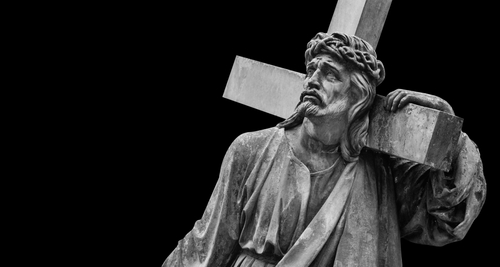
When an Israeli soldier’s sledgehammer blow shattered a Jesus statue in a Lebanese Christian village, it triggered a rare moment of institutional accountability that reveals how quickly damage control works when the optics demand it.
A Sledgehammer Through Diplomatic Restraint
The photograph that went viral on April 19 showed something rare in modern conflict: documented misconduct by a military force, captured and distributed before spin could reshape the narrative. An unnamed IDF soldier, uniform visible, raised a sledgehammer against a Jesus statue in Debl, a Maronite Christian village six kilometers northwest of the Lebanese border. The image spread across social media like wildfire, each share adding another layer of outrage to a story that transcended typical military-operations coverage. This wasn’t abstract policy debate. This was visual proof of desecration.
The Speed of Official Response
What happened next demonstrated institutional reflexes honed by decades of managing international perception. By Sunday evening April 20, the IDF issued a statement confirming the photograph’s authenticity. By Monday morning, military officials had located and identified the soldier. The response escalated vertically: Netanyahu posted on X that he was “stunned and saddened,” Foreign Minister Sa’ar demanded the “strongest terms” of condemnation, and the military promised “harsh disciplinary action.” The choreography of accountability unfolded with precision. The IDF didn’t deny, didn’t equivocate, didn’t hide behind operational necessity. Instead, leadership treated the incident as a values violation requiring immediate correction.
Context Beneath the Sledgehammer
Debl sits in southern Lebanon’s central sector, near territory the IDF has occupied for weeks during operations targeting Hezbollah infrastructure. The village remained populated even as tens of thousands evacuated surrounding areas, making it a pocket of civilian life amid military operations. The statue stood outside a family home, a religious symbol in a Hezbollah-influenced zone where the IDF explicitly stated it had “no intention of harming civilian infrastructure, including religious buildings or religious symbols.” The soldier’s actions contradicted not just official policy but stated military values, creating a narrative problem that demanded swift resolution.
Questions About Provocation
Investigative journalist David Bedein raised a possibility that complicates the straightforward narrative: whether the incident represented a carefully orchestrated provocation designed to damage Israel’s reputation. He noted the “professionally done” method of media distribution and suggested Israel’s adversaries had “been using provocations all along.” The theory remains unconfirmed, but it reflects how contested even documented events become in asymmetric conflicts where information warfare matters as much as military operations. The IDF’s commitment to investigation includes examining this angle, adding another layer to what initially appeared a simple disciplinary matter.
The Restoration as Redemption
The IDF’s pledge to assist the Christian community in restoring the statue served multiple purposes simultaneously. It acknowledged harm, demonstrated respect for religious sites, and created a visual counternarrative to the sledgehammer image. Local priest Fadi Falfel told Reuters that “one of the Israeli soldiers broke the cross and did this horrible thing, this desecration of our holy symbols.” The restoration effort attempts to transform that desecration into an opportunity for reconciliation, though whether the community views it as genuine contrition or performative damage control remains unclear. The statue’s reconstruction will be watched closely by observers tracking Israeli conduct in occupied territory.
IDF confirms photo of soldier smashing Jesus statue in Lebanon genuine, vows action… https://t.co/8xa9cbetK3 pic.twitter.com/5iXvhgQTow
— NA404ERROR (@Too_Much_Rum) April 20, 2026
The incident exposed fault lines in military discipline and international relations. A single soldier’s moment of rage or ideology or provocation became a test case for whether institutional accountability can outpace viral outrage. The IDF’s response suggested yes, at least when leadership recognizes the diplomatic stakes. Yet the underlying questions persist: What prompted the soldier’s actions? Will the investigation’s findings ever reach public knowledge? And most pressingly, how many similar incidents occur without photographic evidence to force acknowledgment? The sledgehammer blow reverberated beyond Debl, raising uncomfortable questions about what happens when documentation is absent and accountability is optional.
Sources
IDF: Image of soldier smashing Jesus statue in southern Lebanon is authentic
IDF confirms photo of soldier smashing Jesus statue in Lebanon is genuine, vows action
Netanyahu says Israeli soldier pictured hitting Jesus statue in Lebanon will face punishment