
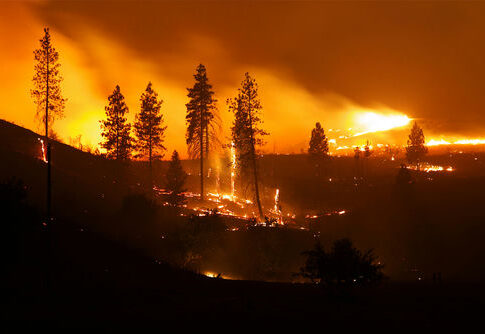
A human-caused wildfire has turned a quiet slice of southern Colorado into one of the largest disaster zones in the state’s history, and the full cost of that choice is only starting to show.
Story Snapshot
- Nearly 67,000 acres burned with 0% containment, making Aspen Acres a top-10 Colorado wildfire
- About 180 structures destroyed across Pueblo and Custer counties, with final counts still uncertain
- Thousands evacuated from small towns like Beulah, Rye, and Colorado City as the fire keeps growing
- Officials say the blaze is human-caused, but the exact spark remains hidden behind an ongoing investigation
A fire that turned a map into a crime scene
The Aspen Acres Fire did not start as a freak lightning strike in some unreachable canyon. Fire officials state plainly that this blaze is human-caused, and that detail changes everything. Flames ignited near Aspen Acres in Custer County on June 29 and quickly pushed into Pueblo County, driven by bone-dry fuels and strong winds. By Friday morning, perimeter mapping showed nearly 67,000 acres burned, yet firefighters still reported 0% containment. That combination—huge size and no containment—turns a map into a crime scene, not just a weather disaster.
This fire is not “near Denver” in the way headlines might make a suburban reader think. The burn area sits roughly 15 miles northwest of Colorado City and about 20 miles from Pueblo, more than 150 miles south of Denver’s city center. That distance matters because it shifts the story from a metro scare to a rural crisis. The people under evacuation orders are not condo dwellers with easy alternatives. They are homeowners, ranchers, and small business owners whose entire net worth may sit on a single piece of land now surrounded by flame.
Small towns emptied overnight by mandatory orders
When the fire exploded overnight, sheriffs did not have the luxury of waiting for perfect information. Mandatory evacuations rolled through communities like Beulah, Rye, San Isabel, Wetmore, and Colorado City. Pueblo County expanded orders after midnight on Friday, clearing all of Colorado City west of Interstate 25. Incident maps show a patchwork of neighborhoods turned into ghost towns so engine crews could work and residents would not die in their driveways. For thousands of people, “home” became a cot in a shelter on Cooper Place or a spare room with friends, with no idea what they would find when they go back.
Law enforcement now reports about 180 structures destroyed, including 125 in Pueblo County and 55 in Custer County. Other officials estimate “more than 200” structures lost. That spread tells you something important. No one has a complete count because the burn area is still unsafe. Deputies and damage teams cannot yet walk every road and driveway. One firefighter has been injured fighting the blaze, and officials say no civilian deaths have been confirmed so far, which is a small miracle given how fast the fire ran. But for many families, the question is not life or death now; it is whether anything physical is left of their life’s work.
Human-caused but still officially nameless
On paper, the cause is “human.” Fire agencies and the National Interagency Fire Center have said the Aspen Acres Fire started from human activity, not lightning. Beyond that, the record goes quiet. No one has publicly stated whether the ignition point was a vehicle, power equipment, a careless campfire, or something criminal like arson. That silence frustrates people who live in the red-flag world of modern Colorado summers. When a single act can erase homes across two counties, residents want names, dates, and details, not a vague label that could describe anything from a broken chain on a trailer to a tossed cigarette.
From a conservative, common-sense view, this gap matters for accountability. If the spark came from negligence, people reasonably want clear responsibility, not a fog of “under investigation.” If it came from poor land management or delayed mitigation work, they want to know why fuel loads near communities were allowed to build. Yet until the investigation finishes, speculating about blame does more harm than good. The fact pattern we do have—human-caused, explosive spread, top-10 size statewide—is strong enough to justify serious questions about how Colorado treats fire risk around small towns.
Disaster status, insurance realities, and who pays
Governor Jared Polis declared a disaster emergency for the Aspen Acres Fire early in the week, unlocking state and federal help for affected areas. That move brings in more crews, air tankers, and funding, but it also highlights a tension many homeowners know too well. Reports from local media indicate that some residents lacked wildfire insurance because coverage was either too expensive or not offered at all in high-risk zones. When flames finally test those financial decisions, the line between “personal responsibility” and “system failure” gets blurry very fast.
NEW: Aspen Acres fire grows to 55,392 acres, making it a top-10 biggest Colorado wildfire on record. It passed the 416 fire (2018) for 10th-biggest fire on record.
55,392 acres = 86.5 square miles = more than half size of the city of Denver. #COwx pic.twitter.com/NEsfhYXfmZ
— Chris Bianchi (@BianchiWeather) July 3, 2026
Hundreds of firefighters and at least seven large air tankers now attack the fire’s edges, trying to keep it off new neighborhoods and key roads. The blaze has already grown enough to rank among the ten largest in Colorado history. At this scale, the story is no longer only about individual victims. It is about whether the state’s rulebook for growth, insurance, and land management fits a climate where one bad decision can erase an entire community. Residents will soon return, count what they lost, and file claims or stand in line for aid. Only then will we see whether the promise of help after a disaster matches the reality on the ground.
Sources:
washingtontimes.com, denver7.com, fires.cornea.is, nytimes.com, pbs.org
Blame environmentalists. They demand that the dry fuels must be left to build the humus in the soil.