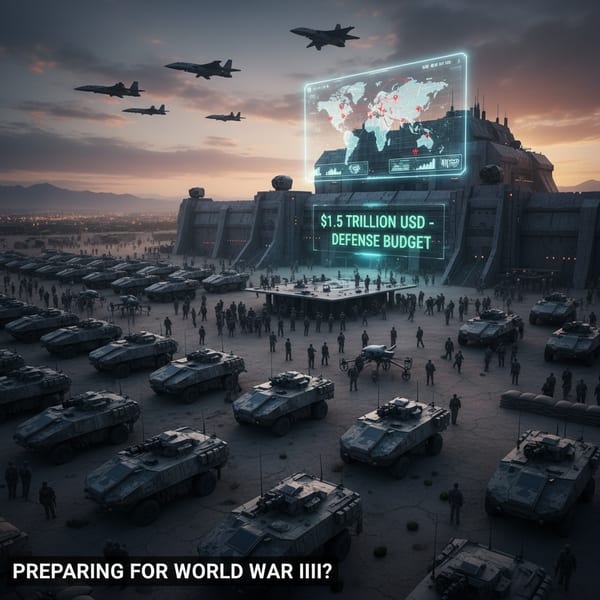
The Trump administration is pushing for a massive $1.5 trillion military budget as the United States remains engaged in an ongoing conflict with Iran, with defense officials planning unprecedented infrastructure expansions for next-generation nuclear weapons systems and stealth aircraft.
Massive Nuclear Weapons Infrastructure Expansion
The Air Force is requesting over $1 billion for Fiscal Year 2027 to support the new Sentinel intercontinental ballistic missile program. The project requires 450 new missile silos, expanded command-and-control infrastructure, and hundreds of miles of buried cabling across three bases. F.E. Warren Air Force Base would receive $632 million, Minot Air Force Base $232 million, and Malmstrom Air Force Base $138.5 million under the proposed budget.

Official name: Nuclear Deterrent System-Air-delivered (NDS-A)
Department of Energy demands $99.7 MILLION to make them
Sixth-Generation Fighter and Stealth Bomber Programs
Nellis Air Force Base requires approximately $730 million in facility upgrades to support the F-47 sixth-generation warplane, scheduled for its first flight in 2028. The base needs new stealth repair facilities, advanced pilot training simulators, weapons storage, and a $192 million apron complex for the Next-Generation Air Dominance program. Meanwhile, the Air Force is expanding infrastructure at Ellsworth, Whiteman, and Dyess Air Force Bases to accommodate the new B-21 Raider stealth bomber, which will replace both the B-2 Spirit and B-1 Lancer fleets.
Strategic Shift in Nuclear Deterrence
The decision to disperse nuclear-capable bombers across multiple bases represents a major doctrinal change for the Air Force. Defense planners cite recent demonstrations of vulnerability, including Ukrainian drone swarm attacks on Russian airbases and American B-2 strikes on Iranian nuclear facilities during last year’s 12-Day War. The expansion comes as China and Russia drive America’s nuclear modernization efforts, with hypersonic weapons making even continental U.S. facilities vulnerable to precision strikes. Critics note the U.S. military remains the world’s most expensive fighting force, yet capabilities continue declining despite increased funding.